
The dryer vent rules your house has to meet
Thirty-five feet, minus your bends. Four-inch smooth metal. No screws at the joints. Here is the rest of what the code asks, and what happens when a run misses it.
Why a homeowner should care about a code section
Because a vent built wrong cannot be fixed by cleaning it. If the run is too long, or made of the wrong material, or joined with screws, it will refill with lint on a schedule no service interval can keep up with.
Knowing the four or five numbers below turns a vague complaint into a specific one. It also tells you whether the person quoting you a cleaning has looked at the actual problem.
Everything here is from Section M1502 of the Florida Building Code, Residential, 8th Edition. Your local building official is the authority on how it applies to your house.
Thirty-five feet, and why yours is shorter than you think
The maximum exhaust duct length is 35 feet, measured from the connection to the transition duct behind the dryer out to the terminal.
That is the starting budget, not the allowance. Every fitting spends part of it. The code's own table charges a 4-inch radius mitered 90 degree elbow 5 feet of equivalent length, and a mitered 45 degree elbow 2 feet 6 inches. Smooth wide-radius elbows cost far less: a 6-inch radius smooth 90 is 1 foot 9 inches, and a 10-inch radius smooth 90 is 1 foot 6 inches.
So a run with four tight mitered 90s has already spent 20 of its 35 feet before a single straight foot is counted. This is the single most common reason a Brevard attic run never dries well. The manufacturer's own instructions can override the table, and where they exist the code says to follow them.
Four inches, smooth, metal, no screws
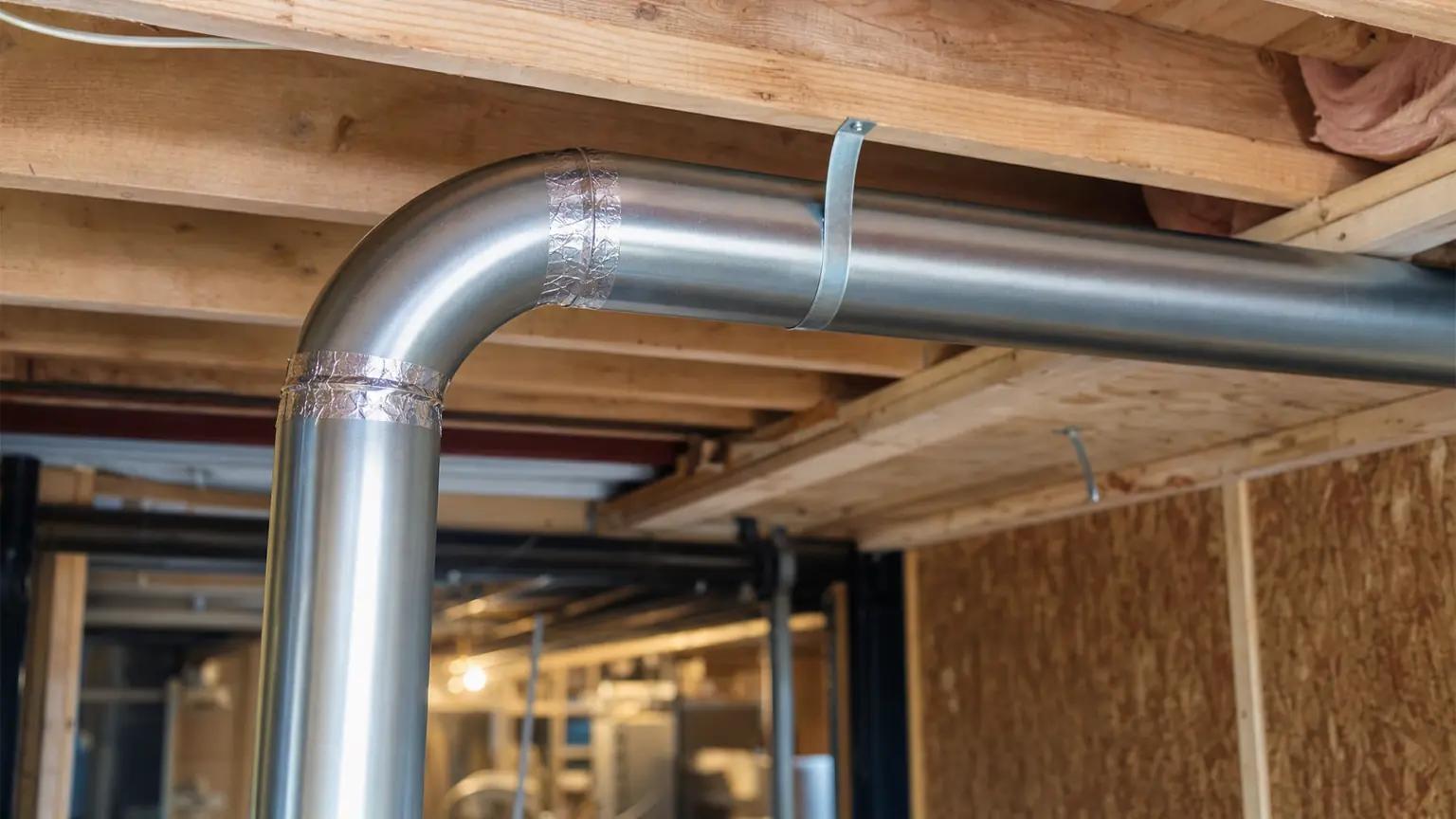
The duct must be 4 inches nominal in diameter, have a smooth interior finish, and be metal of at least 0.0157 inch thickness, which is 28 gauge.
Ducts shall not be joined with screws or similar fasteners. This is the rule we see broken most often and the one with the most direct consequence. A screw point inside a duct is a hook, and lint builds outward from it until the run closes.
The flexible piece behind the machine is a separate thing, called a transition duct. It has to be a single listed and labeled length no greater than 8 feet, and it must not be concealed within construction. Flexible duct running inside a wall or an attic is not a legal vent, and it is the second thing we look for.
Where it is allowed to end
The exhaust has to terminate outside the building, and where the dryer manufacturer does not specify a location, not less than 3 feet in any direction from openings into the building.
The terminal needs a backdraft damper and an open area of not less than 12.5 square inches. That number is the reason a fine mesh screen over a dryer termination is a problem rather than a precaution: it cuts the open area and collects lint on the outside face where nobody looks.
Dryer exhaust also has to be independent of every other system in the house. It never joins a bath fan, a range hood or anything else.
What happens when a run misses
We tell you which rule it misses and what it would take to fix, and we put that in writing with the quote.
A crushed or foil transition hose is part of a normal cleaning visit. Rerouting a run that is too long for its path, replacing a section of the duct, or moving the termination to a different wall is different: that is work outside what we sell. We will tell you it needs doing. We do not do it.
We would rather tell you the run is wrong and lose the cleaning than clean it and let you believe it is solved.
Sources
- Florida Building Code, Residential, 8th Edition (2023), Chapter 15, Section M1502 Clothes Dryer Exhaust
- National Fire Protection Association, Home Dryer Fires (Marty Ahrens, June 2020, NFPA Index No. 3029)
Every figure on this page comes from one of the documents above. Where we could not find a primary source for a number, we left the number out rather than repeat one we could not show you.
Sources verified .
Want your actual number instead of a range?
We measure your attic, tell you the R-value you are starting from, and write the quote in front of you. Free, and you keep the reading either way.