
Why air sealing comes before insulation, not after
Insulation slows heat moving through it. It does nothing about air moving around it. That is why the sealing has to happen first.
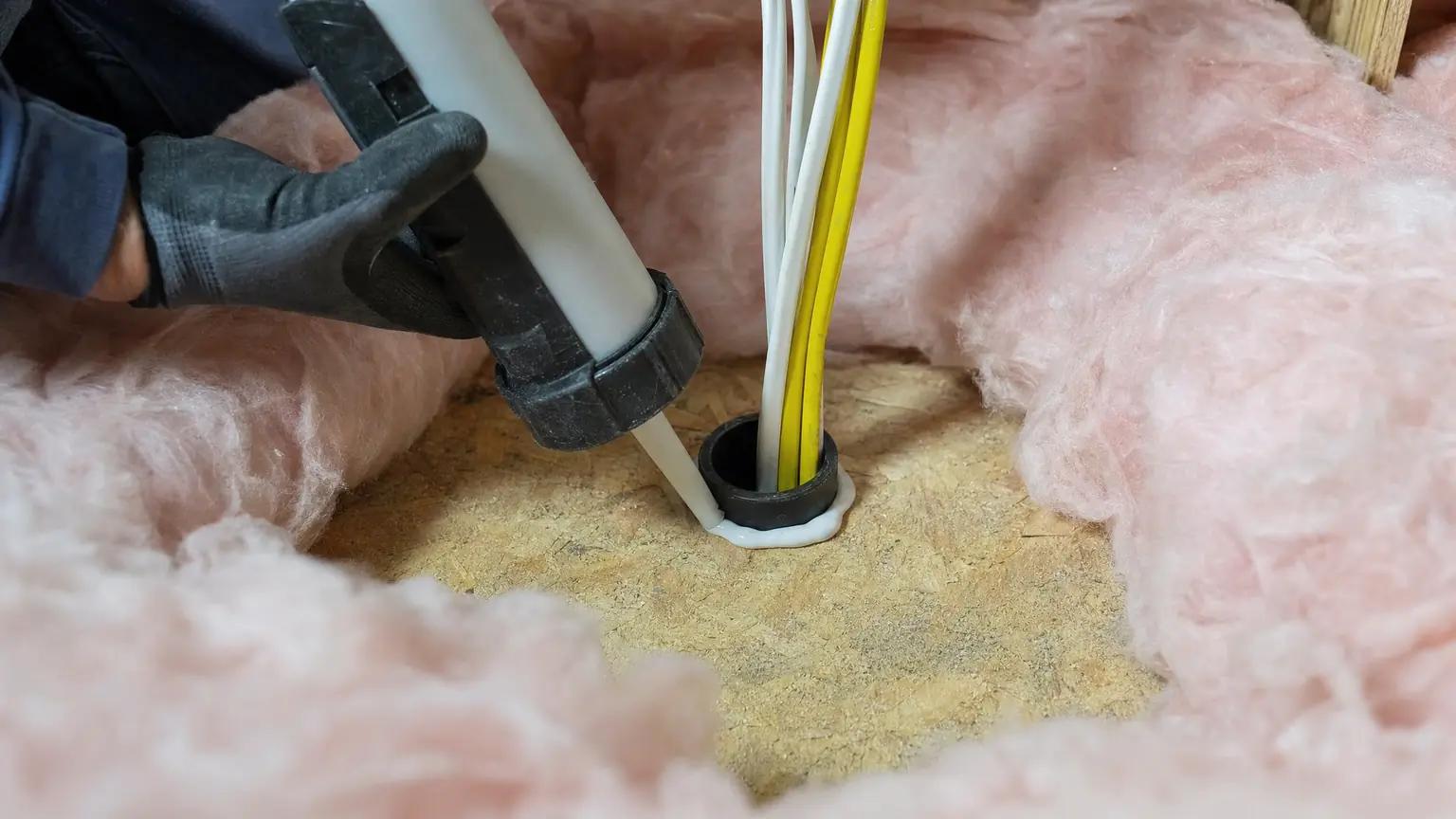
Two different problems, one attic
Insulation is a resistance material. It slows heat conducting through the ceiling, and depth is how you buy more of that.
Air leakage is a separate thing entirely. Every hole through your ceiling plane is a path for conditioned air to leave and attic air to arrive, and no amount of fiberglass over the top of a hole closes it. Blown insulation is air permeable. Air goes through it.
So a house can be at full code depth and still leak. The two measures are not substitutes, and only one of them has an order requirement.
The sequencing rule, from the federal guidance
The U.S. Department of Energy's Building America program sponsored the Guide to Attic Air Sealing and lays out the sequence explicitly. Its own profile of the work states that air sealing all major leaks must be a pre-cursor to installing insulation to ensure the leaks are sealed before they become inaccessible.
That last clause is the whole argument. Once eighteen inches of blown fiberglass is down, the top plates and the penetrations under it are gone. Finding them again means moving the material you just paid for.
The same source calls attic air sealing one of the biggest opportunities for saving energy in existing homes. Its reasons: attics are often accessible, they sit at a critical interface between conditioned and unconditioned space, and they typically contain extensive holes, cracks and penetrations.
What the holes actually are
The holes are rarely dramatic. In a typical Brevard house they are the same short list, and none of them look like a problem from below.
Top plates, where interior walls meet the ceiling and the gap between framing members runs the length of every wall. Plumbing vent stacks. Wiring penetrations. Recessed light housings. Bath and kitchen exhaust fan bodies. The chase around an air handler platform. And the attic hatch itself, which is often the largest single opening in the ceiling and the one nobody weatherstrips.
The reason this matters more in Florida than the national framing suggests is what sits above the holes. Peak attic air was measured at 40°F above outdoor temperature in a Florida test home. Those holes are not exchanging your air with outdoor air. They are exchanging it with 130 degree air.
What the savings actually look like here
ENERGY STAR models air sealing and insulating together, targeting a 25 percent reduction in total air infiltration alongside the insulation upgrade, and publishes the result by climate zone.
The figure most often quoted is the national average: 15 percent on heating and cooling, or 11 percent of total energy costs. For Climate Zones 1 to 3, which is where Brevard sits, the same table gives 5 to 8 percent of total house energy and 7 to 14 percent on heating and cooling alone.
We use the second range on this site, because it is the one about your house. The national figure is pulled upward by heating climates, and quoting it here would be borrowing someone else's winter.
Savings vary. Find out why in the seller's fact sheet on R-values. Higher R-values mean greater insulating power.
How to make sure it is in the job
Ask any contractor quoting you attic insulation one question: what gets sealed before the material goes down, and is it itemized.
A quote that lists depth and R-value and nothing else is a quote for half the work. It is also the half that has to be undone from underneath if you ever want the other half.
It is also worth pairing this with the eave clearance rule, because both are decided in the same hour of the same job. That one is covered in the ventilation guide.
Sources
- U.S. Department of Energy, Building America Top Innovations Hall of Fame Profile: Attic Air Sealing Guidelines
- U.S. EPA ENERGY STAR, Methodology for Estimated Energy Savings from Cost-Effective Air Sealing and Insulating
- Florida Solar Energy Center, Comparative Evaluation of the Impact of Roofing Systems on Residential Cooling Energy Demand (Parker, Sonne, Sherwin and Moyer, November 2000, FSEC-CR-1220-00)
- U.S. EPA ENERGY STAR, Recommended Home Insulation R-Values (from 2021 IECC Table R402.1.3)
Every figure on this page comes from one of the documents above. Where we could not find a primary source for a number, we left the number out rather than repeat one we could not show you.
Sources verified .
The work behind this
Blown-In Fiberglass Insulation
Fire-resistant fiberglass, blown to the depth your attic needs. The pink that lives in our logo lives in your attic.
Batt Insulation Installation
Pre-cut fiberglass for walls, floors, and accessible cavities. Soft, low-dust, GREENGUARD Gold.
Insulation Removal & Attic Vac-Outs
Storm-damaged, rodent-soiled, or 1980s blown-in past its life. We vac it out clean.
Garage Insulation
Walls, ceiling, and the door between the garage and the house. The room your AC is quietly fighting.
Want your actual number instead of a range?
We measure your attic, tell you the R-value you are starting from, and write the quote in front of you. Free, and you keep the reading either way.