
Insulating a garage in Florida, and what it does and does not do
There is no code target for a garage, because a garage is not inside the envelope. Here is what insulating one changes, and the surface most people skip.
Why the advice online contradicts itself
Most of it is answering a code question that does not exist.
The R-value targets that govern an attic come from the energy code and apply to the thermal envelope, the boundary around the conditioned space. ENERGY STAR's recommended values are stated for attics, walls and floors of that conditioned space. A typical attached garage is outside it: not heated, not cooled, not part of the envelope.
So there is no required R-value for a garage in a house like that, and anyone quoting you one as a requirement is quoting something else. Insulating a garage is a decision about what you want the space to do, and the honest way to answer it is to ask what you want.
The wall most people skip, and should not
The part that changes your power bill rather than your comfort is the boundary between the garage and the house.
That common wall, and the ceiling of the garage where there are rooms above it, is real envelope. It is the surface separating conditioned space from a space that sits at whatever Brevard is doing that day, plus whatever a closed garage door adds to it. If that boundary is thin or unsealed, you are cooling against it every afternoon.
It is also the surface most often built to a lesser standard than the rest of the house and then never revisited. If you only do one thing in a garage, do this one, and seal it as well as insulate it. The sequencing logic in the air sealing guide applies here exactly as it does in an attic.
What insulating the garage shell actually gets you
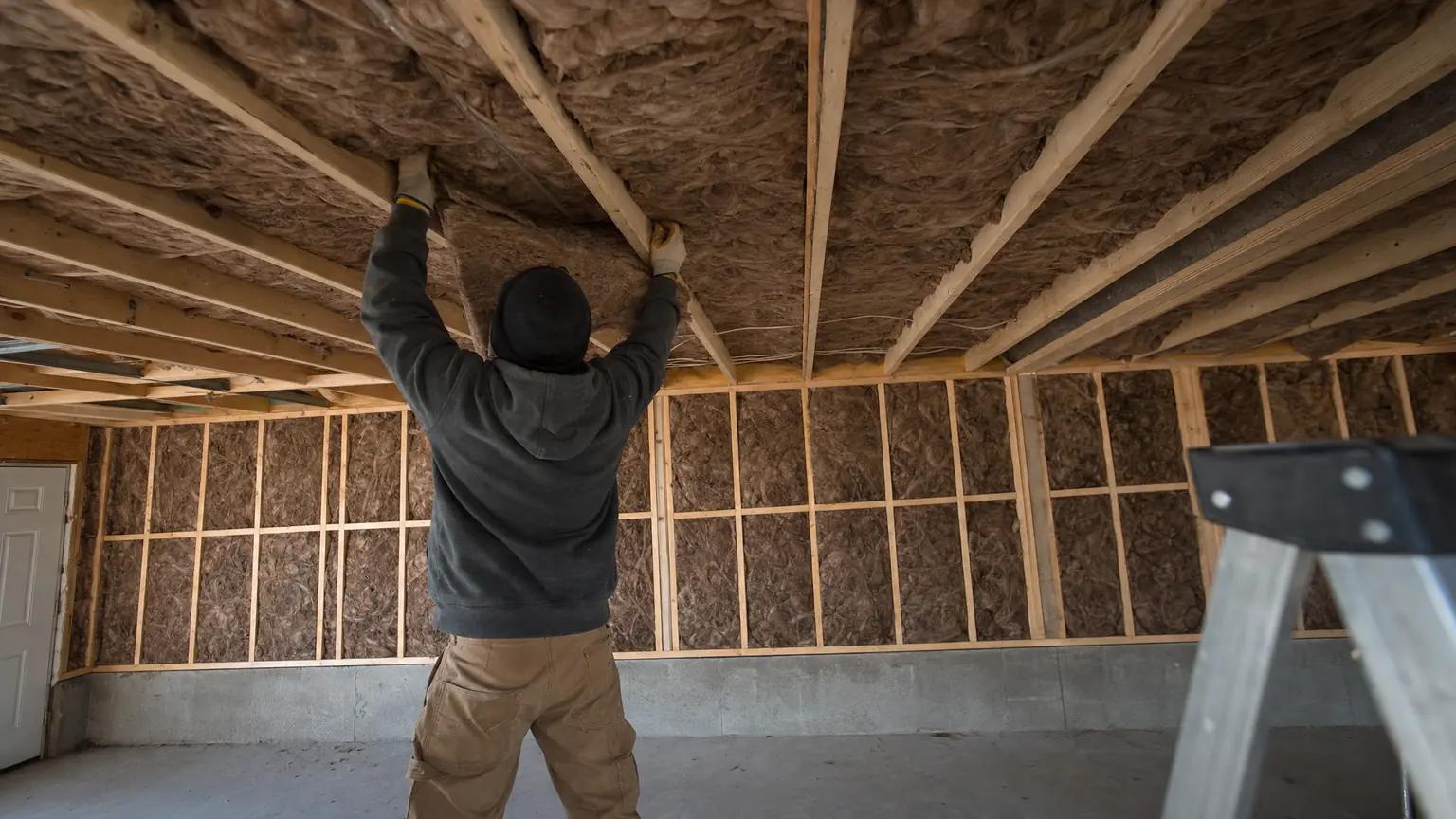
A usable space, mostly, and that is a legitimate reason on its own. A Brevard garage in August is not somewhere you work, and the difference between an uninsulated and an insulated one is large enough to change what the room is for.
Protection for what is stored there. Paint, adhesives, electronics, tools and anything with a battery all age faster in the heat swing.
A quieter, less extreme buffer against the house. This is real but it is second-order. The common wall is doing most of that job, and insulating the garage shell without addressing that wall is the less effective order of operations.
What it does not get you is a cool garage. Insulation slows heat transfer. It does not remove heat. An insulated garage with nothing cooling it reaches a lower peak and holds it longer, which is a different thing from cool and is worth being clear about before you spend money.
The garage ceiling, and the attic above it
If there is attic above the garage, the same conditions that decide an attic job decide this one. Peak attic air was measured at 40°F above outdoor temperature in Florida research, and a garage ceiling under that is taking the same load a house ceiling does.
This is also where the material choice gets decided. Batt works in an accessible framed garage ceiling and on the common wall where the framing is open. Blown-in is the answer over a finished ceiling with attic above it. Neither is better in general; they suit different surfaces, and the surfaces are usually mixed in one garage.
The one thing we will not do
We insulate the shell. Anything involving extending your air conditioning into the garage belongs to a licensed air conditioning contractor, and we will say so rather than take the job.
That comes up more often than you would think, because a well-insulated garage makes conditioning it look cheap. It might be. It is still not our work, and the person who tells you that before quoting is the one to believe about the rest.
Sources
- U.S. EPA ENERGY STAR, Recommended Home Insulation R-Values (from 2021 IECC Table R402.1.3)
- Florida Building Code, Energy Conservation, 8th Edition (2023), Chapter 3 RE, Table 301.1 Climate Zones by County
- Florida Solar Energy Center, Comparative Evaluation of the Impact of Roofing Systems on Residential Cooling Energy Demand (Parker, Sonne, Sherwin and Moyer, November 2000, FSEC-CR-1220-00)
Every figure on this page comes from one of the documents above. Where we could not find a primary source for a number, we left the number out rather than repeat one we could not show you.
Sources verified .
The work behind this
Garage Insulation
Walls, ceiling, and the door between the garage and the house. The room your AC is quietly fighting.
Batt Insulation Installation
Pre-cut fiberglass for walls, floors, and accessible cavities. Soft, low-dust, GREENGUARD Gold.
Blown-In Fiberglass Insulation
Fire-resistant fiberglass, blown to the depth your attic needs. The pink that lives in our logo lives in your attic.
Want your actual number instead of a range?
We measure your attic, tell you the R-value you are starting from, and write the quote in front of you. Free, and you keep the reading either way.