
Why a Florida house feels humid with the AC running
Cold and clammy is a moisture problem, not a temperature one. Here is what is attic-side, and what is not.
The number to measure against
Before diagnosing anything, get a reading. A hygrometer costs very little and turns an argument into a measurement.
The EPA's guidance is to keep indoor humidity below 60 percent relative humidity, ideally between 30 and 50 percent. That is the line that matters, because it is the one tied to mold rather than to comfort.
If you are at 68 percent and 74 degrees, you do not have a cooling problem. You have a system removing heat and not enough water, and the temperature reading is hiding it.
What an attic contributes to this
An attic contributes two things to a humidity problem, and both are ours.
Air leakage through the ceiling. Every unsealed penetration is exchanging your conditioned air with attic air, and Florida attic air is not dry. This adds latent load continuously, all day, on top of whatever the system is already fighting. It is the mechanism described in the air sealing guide, and it is the most common attic-side cause we find.
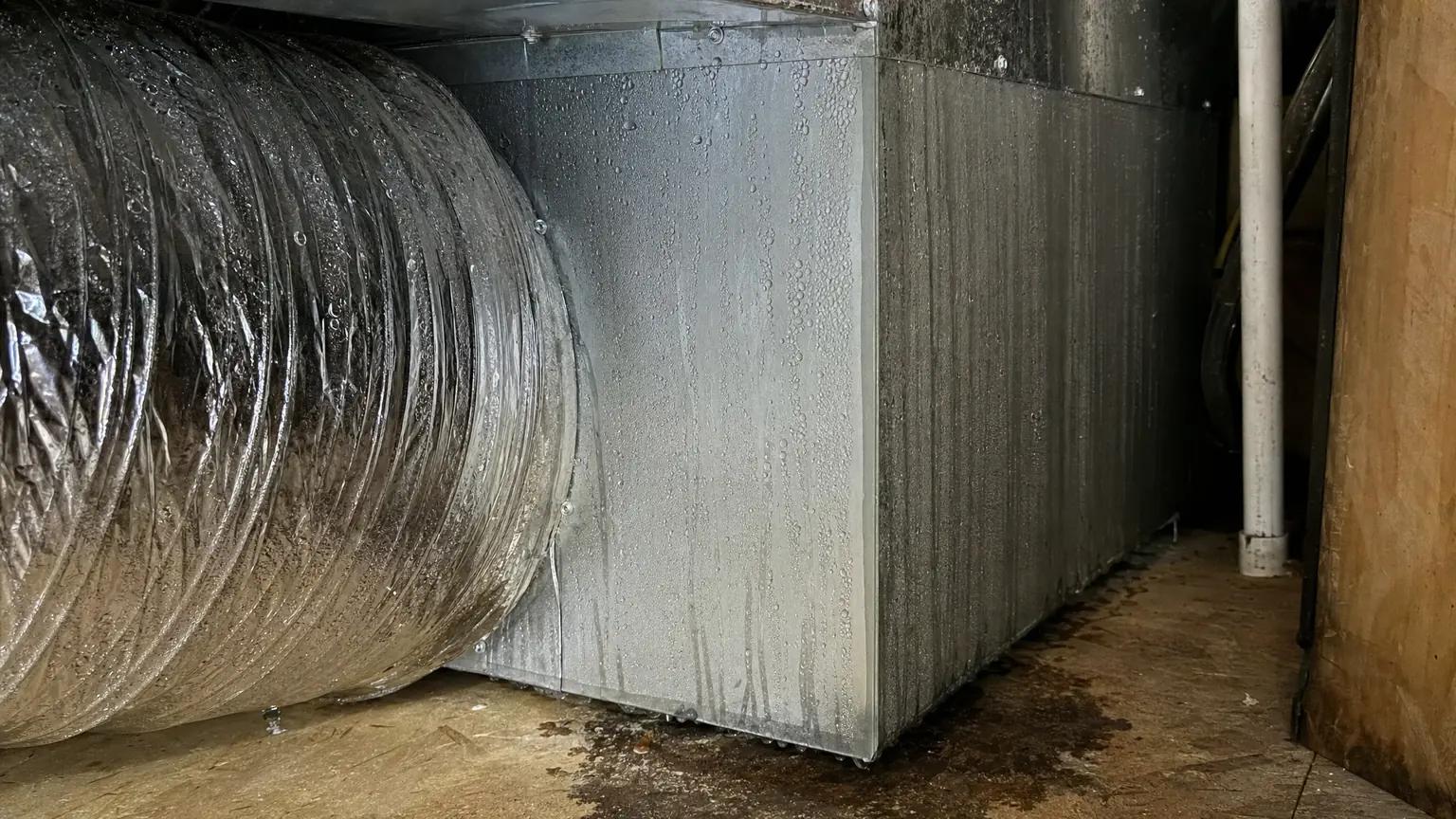
Attic moisture arriving at night. A vented attic breathes in whatever the outside air is doing. The Florida Solar Energy Center's review notes that passively ventilated attics bring large amounts of moisture laden air into the attics during evening hours when relative humidity is often high. It goes on to say this can lead to sweating air conditioning ducts and air handlers, with associated insulation and even ceiling damage. Damp insulation under your ducts, or a ceiling stain with no roof leak above it, is that.
What is not ours, said plainly
The rest of the honest answer is air conditioning work: an oversized system that short cycles, ductwork leaking on the return side, or a house that genuinely needs dedicated dehumidification. We are an attic and air crew rather than a full-service air conditioning contractor, and we are not going to blur that line to keep the conversation.
An oversized system. A unit with too much capacity cools the thermostat quickly and shuts off before it has run long enough to pull water out of the air. Short cycling is the classic cause of a cold, clammy Florida house, and correcting it is a load calculation and equipment decision for a licensed air conditioning contractor.
Duct leakage on the return side. A return pulling attic air is importing humidity directly into the system. Sealing ductwork is licensed air conditioning work in Florida.
Dedicated dehumidification. Where a house genuinely needs it, that is equipment selected and installed by a licensed air conditioning contractor.
If any of those turn out to be the answer at your house, we will say so and tell you what to ask for. That is the whole referral, and there is nothing on the other end of it for us.
The order to work through it
Measure first, for several days, in more than one room. A single reading on a wet afternoon proves nothing.
Look for the cheap sources next: a bathroom fan that vents into the attic instead of outside, a dryer venting short, an unsealed attic hatch. These are common and they are small jobs.
Then decide which of the two lists above your house is actually on. If sealing the ceiling plane is part of it, that work is worth doing on its own merits anyway, because it is the same work the code depth target and the power bill both point at.
Why we care about a number we do not sell against
Damp insulation is dead insulation, and we are the people who end up removing it.
The four conditions that force a tear-out are in the removal guide, and moisture is the first one on the list. A house that runs at 65 percent for three summers is a house whose attic we will eventually be vacuuming out.
Sources
- U.S. EPA, A Brief Guide to Mold, Moisture and Your Home
- Florida Solar Energy Center, Literature Review of the Impact and Need for Attic Ventilation in Florida Homes (Danny Parker, May 2005, FSEC-CR-1496-05)
- U.S. EPA ENERGY STAR, Methodology for Estimated Energy Savings from Cost-Effective Air Sealing and Insulating
Every figure on this page comes from one of the documents above. Where we could not find a primary source for a number, we left the number out rather than repeat one we could not show you.
Sources verified .
The work behind this
Insulation Removal & Attic Vac-Outs
Storm-damaged, rodent-soiled, or 1980s blown-in past its life. We vac it out clean.
Blown-In Fiberglass Insulation
Fire-resistant fiberglass, blown to the depth your attic needs. The pink that lives in our logo lives in your attic.
Batt Insulation Installation
Pre-cut fiberglass for walls, floors, and accessible cavities. Soft, low-dust, GREENGUARD Gold.
Want your actual number instead of a range?
We measure your attic, tell you the R-value you are starting from, and write the quote in front of you. Free, and you keep the reading either way.